
Episode 75StrategyFor The Daring Growth Seekers
What NZ Business Leaders Really Think About AI
23 min
Hosted by Jordan McFadyen




Show notes
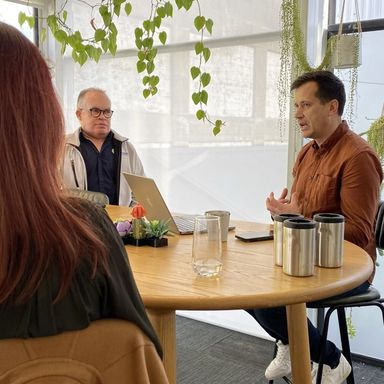
Forget the generic AI reports from the US. We wanted to know what's actually happening with AI right here in New Zealand, so we sat down with a group of local business leaders for a frank roundtable discussion.
This episode is a recap of that conversation. We cover the surprising ways AI is being used (and the tools people are actually choosing), why clinging to old tools like spreadsheets is holding businesses back, and how the conversation around AI taking jobs is far more nuanced than you're being told.
If you want an on-the-ground perspective on how Kiwi businesses are navigating AI, this episode gives you a seat at the table.
In this episode, we cover:
- 02:21 Key Insights and Learnings from the Round Table
- 03:45 AI Tools and Their Impact on Business Processes
- 06:19 The Role of AI in Replacing or Enhancing Jobs
- 09:01 Importance of Brand Voice in the AI Era
- 17:25 Data Security Concerns and Education Gaps
Follow us for marketing wisdom straight to your feed
Instagram: https://www.instagram.com/donebynine.marketing/
LinkedIn: https://www.linkedin.com/in/jordan-mcfadyen/
Thank you for tuning into For The Daring Growth Seekers - brought to you by Done By Nine, a marketing agency for the AI-era.
Don’t forget to hit subscribe (so you never miss an episode)!
If you love this show, please leave us a 5-Star Review!
We really appreciate your support.
In this episode
TranscriptLightly edited. About a 19-minute read.
Jordan: So earlier this week, we sat down with a group of business leaders to chat all about AI, and how it is shifting the marketplace, how we do business, how people find us, how people work with us. And we did it in a roundtable format. And we thought today we’re going to sit down and actually go over some of the results, some of the insights, some of the things that were discussed, because I think it was an interesting discussion. So, yeah, I’d be keen to do a bit of a recap. If we haven’t met before, you haven’t listened before, welcome to For The Daring Growth Seekers podcast.
Jordan: My name is Jordan. This podcast is all about trying to help you navigate this cluttered world of marketing and business in the AI era. And joined today by Aarti from the team as well. Aarti, good morning. How are you?
Aarti: Good morning. I am well, thanks.
Jordan: Yes, I thought it could be cool just to do this little podcast, little roundup, essentially, because obviously we spent a bit of time with some businesses this week. So firstly, shall we just give a little overview about what the roundtable, what was the point? Why did we want to bring people into one room and kind of chat about these different things?
Aarti: Yeah, absolutely. I think that we wanted to host something at kind of a more elevated level. Like, obviously, Jordan, I know that you run AI workshops, and that brings about a lot of practical insights of people doing things in the workshop, at that exact time. And I guess what we thought would be great about a roundtable is actually hands off the tools, pitching it to business leaders who are working on the business just as much as they are working in the business.
Aarti: But being able to kind of elevate that and look at it from a higher level, to say, how is AI impacting their businesses? And being able to bring together opposing or differing or similar kind of industries in a room, to be able to look at the impact of AI across industries, rather than just a single output of, like, we’re making our operational efficiency better. Kind of looking at it from a holistic point of view, and being able to look at it at a higher level and say, actually, how is this impacting all the different layers of my business, and in what way?
Jordan: And do you know, the other key learning that I had, and we’ll go through some of the learnings and some of the key kind of points that we discussed during the session, just to kind of share as much as we can. But essentially, one of the big things that I learned as well is, obviously, you can read a lot of different industry reports. Obviously, a lot of the data that we get is out of the States, and what Google’s saying about this and what Meta’s saying about this, and then obviously some broad New Zealand reports, Australian reports, talking about how AI is disrupting this industry and that industry, and head counts down, and all that type of thing.
Jordan: But then when you actually break it down to really focus on different niches and different industries, different businesses and different smaller businesses as well, it is actually interesting to see how it can challenge some of those big pieces of data as well. And I think that was, for me, one of the really interesting things as well, is actually getting a good insight, and actually hearing some of that feedback out of the businesses’ mouths, essentially. That these leaders are actually coming to us and actually saying, well, yeah, that’s all well and true for what Google’s saying, but for us, it’s actually this, and it’s completely different.
Jordan: So I think that was one of the key things. So let’s go through some of those key talking points that we kind of looked at, and even just kind of give a bit of an overview about some of the key things you kind of took away from it as well.
Aarti: Yeah, absolutely. I think across the board, people obviously are using AI in some capacity, and I think that obviously still came out across the businesses that we spoke to. And then also what I did notice a lot was that the businesses also would use, if they’re a Google Workspace, they’re probably going to use Gemini. If they’re a Microsoft, then Copilot was most likely going to be their preferred, which absolutely makes sense. But also it was interesting, because I haven’t used Copilot before, because we are obviously a Google house. But also the nuances between all of those different channels as well, I thought was quite an interesting piece.
Jordan: The other big piece as well was around the discussion around how, if essentially you don’t adapt. And I think one of the things that one of the attendees actually said was literally, and he kind of put like, if you haven’t adapted and kind of adopted some sort of AI tool into your business by March, you’re essentially screwed. And I think that’s one of the key learnings that kind of came out. And also some of the other one, around clinging on to some of those legacy tools. And the legacy tool that was brought up in the roundtable as well was businesses that are still clinging on to tools like the spreadsheet, and jumping into Excel.
Aarti: I loved that. I thought that was such a funny but also awesome insight, because obviously people who are spreadsheet driven, they just would not look at any other tool. Like, really, people who love spreadsheets, it would be pretty hard to switch them to another tool.
Jordan: You love a spreadsheet, don’t you?
Aarti: Like, I’m not a massive spreadsheet or numbers person, but I know lots of people who are. Like my husband, he loves a spreadsheet. He loves the formulas. Trying to get him off that, to use a tool to do something else, it would be tough.
Jordan: And even thinking about how you can use these AI tools to then enhance those spreadsheets, and be able to build them faster. Like I know, and again, using Google Workspace, and I know Excel does the same, but being able to actually come up with the formulas much, much quicker. Essentially saying, look, we need this column and this column to do this, and to give us this output. What formulas do we need to use here? Being able to make those quicker decisions, and just get that faster guidance. I think that was one of the key things I kind of took away as well, is that’s where a lot of these businesses are kind of using these different tools.
Jordan: And I think the other big thing, that I did a post on LinkedIn around, this next kind of thing that I learned as well, which did generate an interesting comment as well, which was essentially around how I got the feeling from the roundtable that obviously AI is replacing a lot of junior roles. But I didn’t get that feeling around the table here, especially because the type of industries and businesses that we’re having here, there were a lot of construction, engineer type businesses that are doing things like tenders, where the senior member of a team would be doing that. So instead of AI replacing a junior member, for those type of businesses that were in the room, they weren’t doing that. It was more that AI tools were helping those senior leaders be able to do their process faster and better and more efficiently, which then means that they can be able to get through, let’s say, that tender process much quicker.
Jordan: So, yeah, slightly controversial take, but I guess it goes back to what I’m saying before, around that, if we have a look at a broad context, yes, AI is replacing a lot of junior roles. But from the context of the businesses in certain industries, it’s potentially not replacing junior roles, but actually helping to enhance senior roles, which then I can see can then actually help create positions for junior roles. So if you’re more efficient in your senior leadership team, so if you’re more efficient with getting tenders out and being able to win tenders, for example, if you’re in an engineering firm or a building firm or anything like that, then being able to use AI to help project manage, and be able to save and scrape time off a project, to be able to manage your team better. I then see that then there’s an opportunity to create more labour-intensive work for junior people.
Jordan: So I guess that was one of the big learnings for me. Yeah, there’s a lot of stuff around AI is taking my job, AI is doing that, it’s going to disrupt this industry. But also, flip of the coin, it’s not all like that. I guess it’s just trying to think slightly different around how AI is actually helping to support some positions, to then be able to potentially create junior positions as well. I don’t know if that’s just my take on it.
Aarti: Yeah, I definitely thought that was a definite sentiment in the room, and I was quite interested by that as well, because I thought there would potentially be a little bit more worry around those lower work levels. But I guess for industries that have people on the ground and on site, that’s probably not as much of an issue, because, as the people around the room said, the people on site, they’re not about to be replaced by robotics or anything anytime soon. Those people are still going to be needed. So in terms of workforce for these industries, it was staying strong.
Jordan: Yeah, definitely. The other big piece that kind of came through, and leans more into the marketing space quite a bit, was that shift around how brand voice and branding is going to become, and has always been, obviously, very important for a business, but is going to become even more important.
Jordan: And again, I guess if we go back to that tender process, everyone is now using some form of AI. So let’s say that you’re doing proposals, or any type of B2B business that you’re in, most likely you’re doing some sort of proposal, some sort of quote, potentially in some sort of tender process, or potentially competing against other local businesses as well. Everyone is using some sort of form of AI to build these proposals or these quotes. So the question then becomes, how do you become different in that space? And how does your own brand and business stand out against all of these people who are essentially vying out for the exact same thing, saying essentially that they can do the exact same thing? And so…
Aarti: Most likely for about the same price, if you’ve done your competitor analysis correctly.
Jordan: Exactly.
Aarti: So, yeah, that was a really strong one. That was a great insight for us, and obviously was pretty obvious as marketers. Obviously, we know that brand, and that tone of voice, and all of those types of things make your business and your brand. But hearing that from businesses that aren’t really doing marketing in that sense, and them identifying that is actually a key thing, was really validating. And also hearing it from leaders who are not marketers as well. These are leaders who are in the tender process. They’re general managers, they’re project managers, they’re running businesses, as opposed to trying to think about marketing. Obviously, if you’re in that type of seat, you’re always got a bit of a marketing hat on, but I guess it was really reassuring and refreshing to hear that people were thinking a lot about that.
Jordan: Yeah. And I guess for my thing that I kind of took away as well was, and I know we say this a lot, is thinking around how you can pull into those proposals and those tenders around that E-E-A-T principles: the expertise, the authoritativeness, the trustworthiness of you and your business. And that you’re actually going to get the job done for this price, and that you’ve got the authority to, and the experience to, actually give that confidence to that person reading that proposal, that job is going to be done while the price is the price. It is actually going to be able to get there, and you’re not going to have any headaches along the way at the same time, you know?
Aarti: Yeah, absolutely. What would your advice be to people using AI for things like tenders, to try and bring in their brand and tone of voice and stuff? What would be a practical output of that?
Jordan: So this is where I think that we need to be thinking around, if you’re going to be using AI tools for these type of processes, which I believe you should, because it does speed up the process a lot. But this is where I think it comes down to effective prompting as well, and trying to think about how, even if you can create, and this is something we run through with some of our workshops and things like that as well, is if you can create some sort of brand voice document. And I was talking to a client yesterday, actually, and we’re going to be delivering a workshop in Melbourne next week with a large government organisation.
Jordan: And what they were talking about, and what was really interesting, is they’ve got really detailed brand guidelines, but what they don’t have is brand guidelines that are essentially set up for AI machines. So what I was trying to say to them is, what we need to be doing is thinking about how can you take our brand guidelines that we’ve been used to for the past how many years, and actually be able to create a prompt-worthy brand guideline. So essentially, so we can actually go in and build a prompt, and be able to say, look, this is what we’re trying to do. This is the template we’re trying to fill. And this is our brand voice guideline. And this is who we serve as a person. And so every prompt is giving as much data as possible. So it just takes a slightly different approach to brand guidelines.
Aarti: I love that. I think that’s really interesting. And I would love to roll that out across so many different applications. ’Cause I think you’re right. It’s not just about, like, obviously we build brand guidelines for clients all the time, but I think having that other layer of, like, okay, but what could it actually look like? And it’s like that brand guideline to an AI tool, so that they also understand.
Jordan: ’Cause again, one of the other things we were discussing with that particular example was, how do you build the briefs for a design team? And how can a marketer who’s not a designer be able to build a brief? So being able to use those brand guidelines, and be able to make sure that’s included in those prompts. I think that really comes into it. And that kind of comes full circle to what we’re talking about here, with even the tender and the proposal process and the quoting process, is about how can we actually pull all of that together and pull in your brand.
Jordan: And it goes back to that thing that we talk about a lot in our workshops, that the output is only ever going to be as good as the input. If you’re just going to go to ChatGPT and say, I’m quoting for this job, this is how much it is, this is our process, give me a proposal, it is going to look like every other person’s tender, every other person’s quote. You don’t understand our… Yeah. But if you can think about how it can be slightly different. And I know there are some caveats, especially in the tender process, that there’s essentially a pretty basic formula PDF that you have to essentially fill in. But there’s still ways, I believe, that you can actually bring in some of the expertise and that brand voice, so that people actually understand who’s actually reading and who’s actually going to deliver that job.
Jordan: The other big thing that I was thinking, as they were discussing that as well, and I don’t know how this is going to go in the future. One of the big things I was trying to question was, who’s actually reading these proposals and these tender documents? One day down the line, are we still going to be sending these proposals and these tenders and our quotes to people? Or are people already at the stage of taking all their tenders, all their quotes, all their proposals, chucking it into ChatGPT and saying, hey, what’s your best? Can you give me a detailed breakdown?
Aarti: So the bot is deciding, as opposed to the person. I actually was kind of surprised that it was still so manual, like a person reading all of them. ’Cause I thought that AI would have come into it a little bit, even obviously to weed out X, Y, Z, or based on a certain criteria. So I was still quite surprised that it was quite a manual journey.
Jordan: And one of the people at the table actually shared a fascinating story as well, where they were working with an insurance broker. The insurance broker had presented different options for their business, for their insurance renewals. And the client actually took the step to put all those proposals into ChatGPT, or the AI tool that they were using, to be able to come up and compare the different options. And they found a couple of gaps, a couple of loopholes. They presented it back to the broker. And supposedly the broker even said the words, I didn’t think of putting them into ChatGPT. And I’m thinking that this is a massive opportunity for businesses, that they need to be… And especially in that broker space, where you are dealing with a lot of different quotes, using these tools to then present the best option.
Jordan: But it did make me think, okay, shit, this person was using AI to take those different insurance quotes and figure out which is the best for my particular needs. And are we starting to… And I did the same when choosing, I can’t remember what product. Oh, we’re having a look at changing our broadband provider here at the office. I’ve literally put in all the different proposals into ChatGPT. So I’ve still got a bit of a bias, in terms of the people that I’ve dealt with personally with that process, but obviously the numbers and the proposals are big bias as well. And the price, and those type of things as well.
Aarti: And the contract behind, like, all of these little different things, which you’re not usually reading line by line, for it to then come and be like, oh, this one actually says this, there’s a break clause, or there’s a this, that, you might not have looked at. It’s nice to be able to have that come to you, rather than having to read screeds of pages of documentation.
Jordan: Exactly. Exactly. So yeah, real interesting point. Some of the other real quick things: data and security. We spoke about that briefly. Wasn’t actually a massive concern for businesses in the room, but I also think that’s probably an issue that they weren’t concerned, or that they weren’t thinking about it.
Aarti: Yeah. I was quite surprised that there was little to no thoughts around that, and even thoughts around it being like a risk at all. They just said it flat out wasn’t. I do agree that there is the sentiment of one of the people around the room, who said, there’s just so much data, we’re just a tiny speck, and it really doesn’t matter.
Jordan: Yeah. And I think that probably is kind of right, and I do agree with it. And I do actually think, though, that their industries, it’s not that relevant. And I think that across other industries, which, I feel like it’s just quite variable, other industries, for example, some of the clients that we have are very data secure. That’s one of their high needs. And they have everything across their business needs that security layer. Whereas I think some of the industries in the room that we spoke to, it’s not such a big thing. Which was interesting.
Aarti: Yeah, I was quite surprised, but I mean, it was nice to hear. I mean, this is kind of the point of these types of roundtables, to be like, oh, we thought that this might be an issue. And they’re like, actually, we don’t give a crap.
Jordan: So, yeah, it kind of goes back to what I said at the start, around, I think, sitting with a room of actual businesses, as opposed to just reading what we see online and large pieces of data. Trying to actually understand the nuances has been really helpful with that, and trying to understand that piece much, much clearer, I guess.
Jordan: The other big thing was, essentially, there is still a massive gap in terms of education around this. And I still think there’s a massive opportunity for teams themselves, senior leadership teams, to understand these tools, to understand how they can actually use these tools, even at a basic level. One of the big things that we’re seeing, and again, going back to that Australian organisation that we’re dealing with next week, which was that their team are just so widespread, between real basic people who are using, like, workflows. So it’s kind of like, how do you kind of bridge the gap, and trying to get people at least into that centrepiece?
Aarti: On the journey, yeah.
Jordan: Into that centrepiece, without having to think about building these complex workflows and things like that, but at least starting to use it. And I feel as though that the more teams that we talk to now, the gap is just widening massively, which then I believe is going to start this kind of disconnect. And there’s going to be marketers and marketing teams that are still using very basic tools, and potentially not being as efficient as some of the people that have got these complex workflows. And within teams, it’s just going to get really disjointed and become a challenge over time as well. So I do think that education piece was really key as well.
Aarti: Yeah, and that goes hand in hand with the generational gap in lots of these different cases as well. So I think that things like training, workshops, all of that type of stuff, is going to be more important to bring people onto that journey, rather than have this massive disconnect.
Jordan: Cool. Any other final points you thought of?
Aarti: No, I don’t think so. I think it was a great roundtable. I think that it was really interesting, and we came out with some great insights.
Jordan: Yeah, I think so. And I think probably something that you and I both came away from, obviously, with new ideas, new perspectives on things, new ways to kind of challenge our thinking, but also, yeah, kind of a format that I think was actually quite helpful. So I’d be interested, we’ll look at doing these again as everyone’s kind of journeys continue and change and adapt, because obviously these tools are changing wildly. And I guess that was actually another big thing we didn’t touch on, is that one of the issues that they are facing is that they finally get the handle of a tool, and it’s like, oh, cool, we’ve figured that out. Then, bam, switched, and there’s a new model out, and it changes completely what you’ve got to do. So, yeah, I guess having these conversations is really important.
Jordan: What we are going to do, though, is we’ve actually taken everything we’ve spoken about here. We’ve taken the transcript from our meeting that we had with those people. We’ve put it up into a PDF. It’s got all the information, so you can kind of get a bit of an understanding. Hopefully it challenges some of your thinking, the way that it’s challenged our thinking around AI. We’ve even put some strategic implementation ideas in there. We’ve put some insights that we got from there. Just some ideas to help you and your business and your team kind of start to think about AI, and start to notice some of the gaps that other businesses are seeing. A, to see whether you’re in the same boat, and things that maybe you’re excelling in, maybe things that you’re behind the eight ball in. To hopefully get us all, it goes back to the education piece, and hopefully get us all moving in that same direction, and actually using these tools really efficiently as well.
Jordan: So, Aarti, thank you so much for, A, organising the roundtable, for giving us the roundup, and for facilitating the conversation. And, yeah, looking forward to the next one.
Aarti: Yeah, me too.
Jordan: And, look, if you’re interested in getting this document that we’re talking about here, you can go to our website, donebynine.com. We’ll also circulate it across our socials on LinkedIn and Instagram and things like that as well. And we’ll continue to share new insights as they come to us around this AI journey that all these businesses are going on. And, again, thanks so much, Aarti, for joining us. And thank you so much for listening. And we’ll see you on another episode of For The Daring Growth Seekers.